Interindividual Behavioral Variation Post-Predation: Week 2
Introduction
In social invertebrate colonies, individual behavioral differences may either remain fixed across fluctuating ecological contexts (representing static personality syndromes) or adjust dynamically following energetic inputs, predatory stress, or foraging success.
In this follow-up investigation, surviving individuals from the Week 1 Stegodyphus cohort were maintained communally for seven days, during which they constructed a dense communal silk retreat web. We introduced live prey (Tribolium castaneum and Tenebrio molitor larvae) to stimulate vibration-guided communal predatory responses, followed by post-foraging re-assessment of individual boldness and aggression scores.
Hypothesis: Relative rank-order personality scores remain stable across repeated trials, with no fundamental realignment of behavioral syndromes post-predation.
Materials and Methods
Materials
- 4 surviving velvet spiders from Week 1 cohort (2 individuals died prior to Week 2 testing)
- Live insect prey: Tribolium castaneum larva (small), Tenebrio molitor larva (large)
- Stereomicroscope, fine forceps, blunt tactile probes
- Digital stopwatch
Methods
Spiders were monitored in their communal webbed arena. A T. castaneum larva was positioned at the dense central retreat hub, and behavioral interactions were recorded for 25 minutes. A larger T. molitor larva was subsequently introduced, with observations recorded for an additional 25 minutes.
Following prey capture interactions, spiders were separated into individual chambers and re-tested using the identical pneumatic boldness assay and tactile aggression scale established in Week 1.
Data
Boldness Scores Across Timepoints
| ID | Name | Colour Mark | Boldness 1 (Pre) | Boldness 2 (Post) | Status |
|---|---|---|---|---|---|
| 1 | Olaf | White | 540 | 529 | Alive |
| 2 | Peter Parker | Blue/Red | 543 | — | Deceased |
| 3 | Nemo | Orange | 577 | 576 | Alive |
| 4 | Shrek II | Green | 580 | 574 | Alive |
| 5 | Barbie | Pink | 531 | — | Deceased |
| 6 | Bob | Yellow | 536 | 503 | Alive |
Aggression Scores Across Timepoints
| ID | Name | Mark | Aggression 1 | Behaviour 1 | Aggression 2 | Behaviour 2 | Status |
|---|---|---|---|---|---|---|---|
| 1 | Olaf | White | 1 | Huddle | 1 | Huddle | Alive |
| 2 | Peter Parker | Blue/Red | 1 | Huddle | — | — | Deceased |
| 3 | Nemo | Orange | 1 | Huddle | 2 | Run | Alive |
| 4 | Shrek II | Green | 3 | Walk | 2 | Run | Alive |
| 5 | Barbie | Pink | 3 | Walk | — | — | Deceased |
| 6 | Bob | Yellow | 6 | Leg raise | 6 | Leg raise | Alive |
Results
Summary Statistics (
Sample mean (
| Trait | Timepoint | Mean ( | Std Dev ( | SEM | |
|---|---|---|---|---|---|
| Boldness Score | Timepoint 1 (Pre) | 4 | 558.25 | 23.47 | 11.74 |
| Timepoint 2 (Post) | 4 | 545.50 | 35.69 | 17.84 | |
| Aggression Score | Timepoint 1 (Pre) | 4 | 2.75 | 2.36 | 1.18 |
| Timepoint 2 (Post) | 4 | 2.75 | 2.22 | 1.11 |
Cohort Mean Trait Shifts
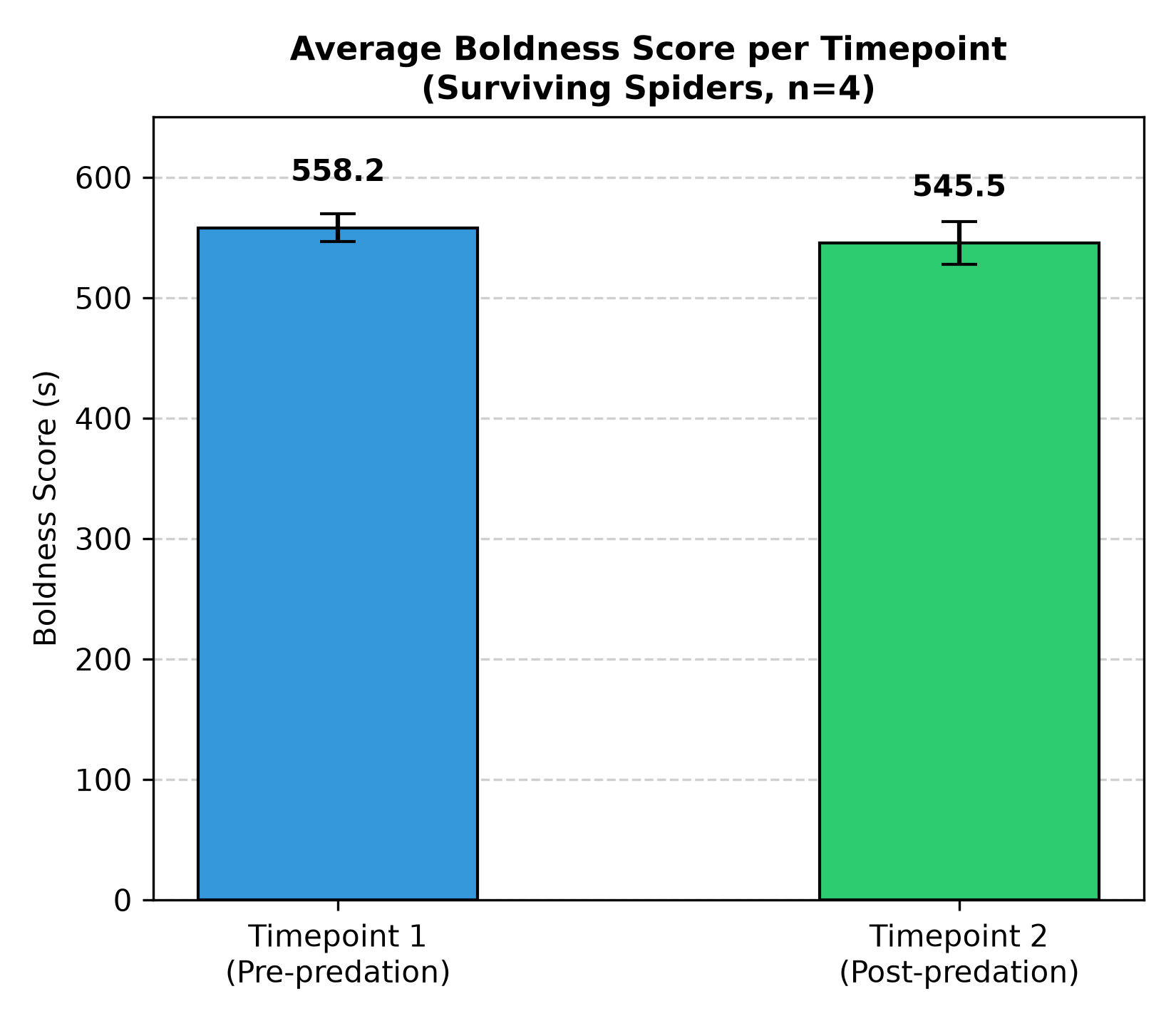 | 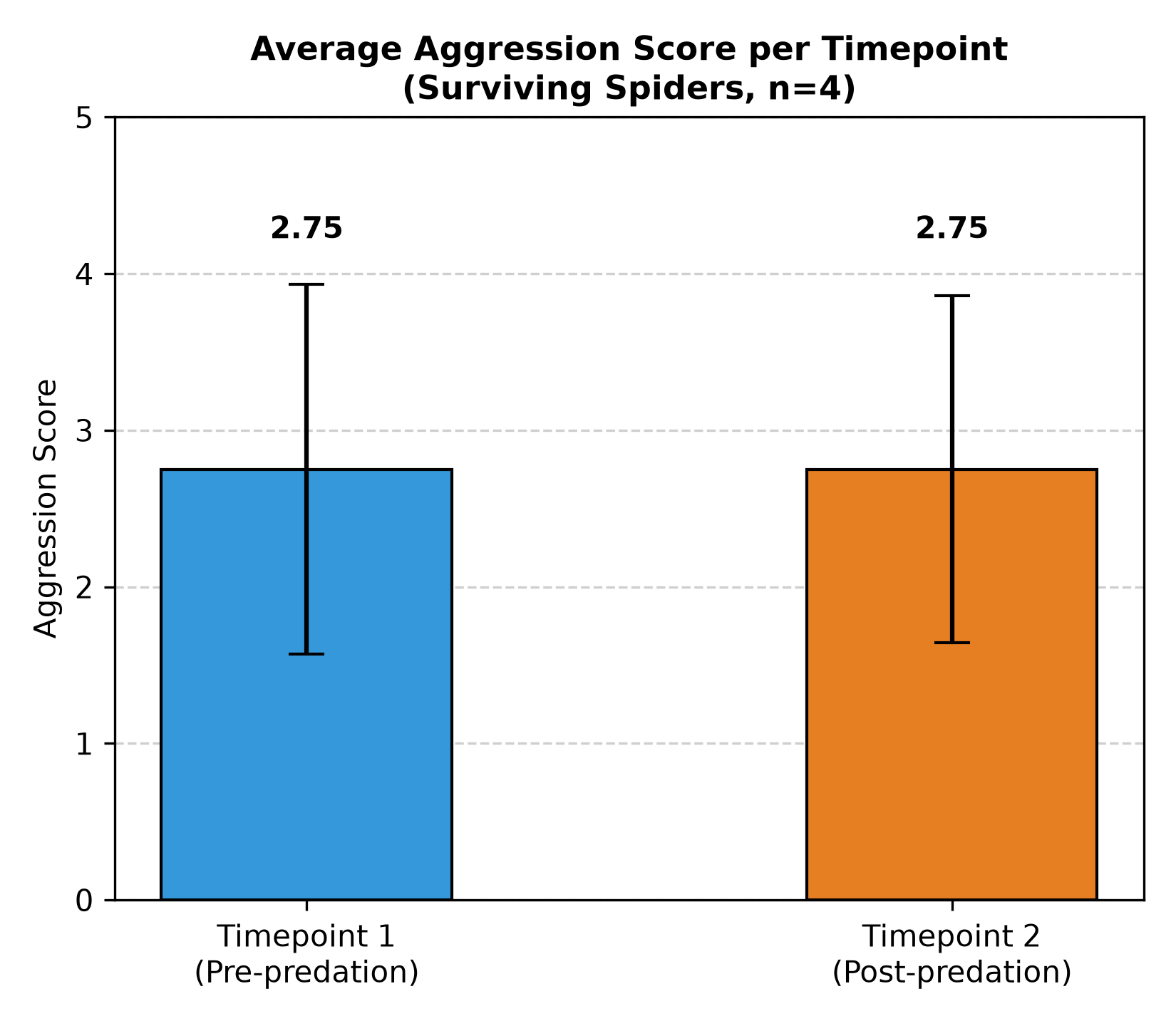 |
|---|---|
| Mean boldness score across timepoints ( | Mean aggression score across timepoints ( |
Mean boldness declined modestly (
Individual Behavioral Trajectories
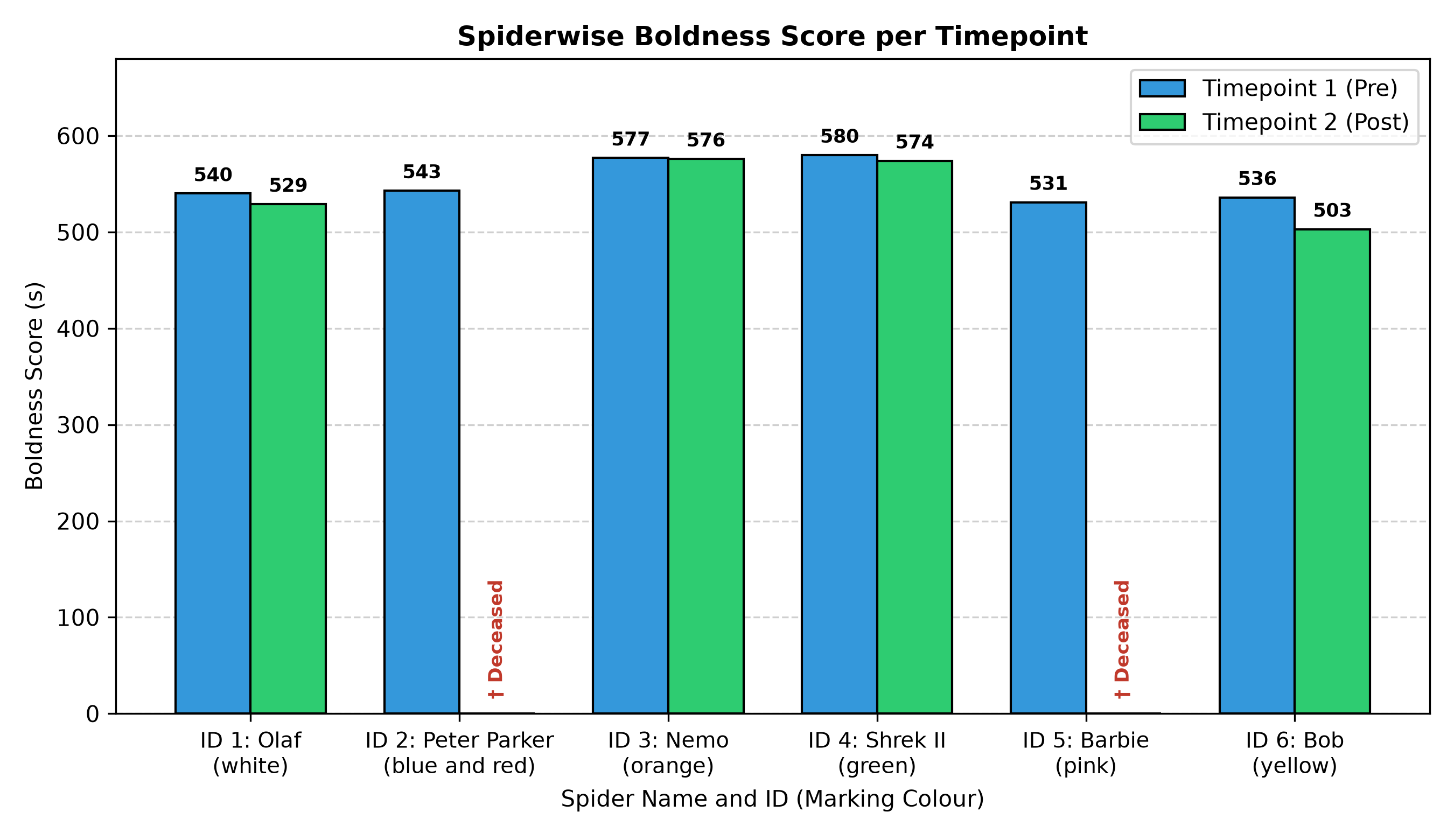 | 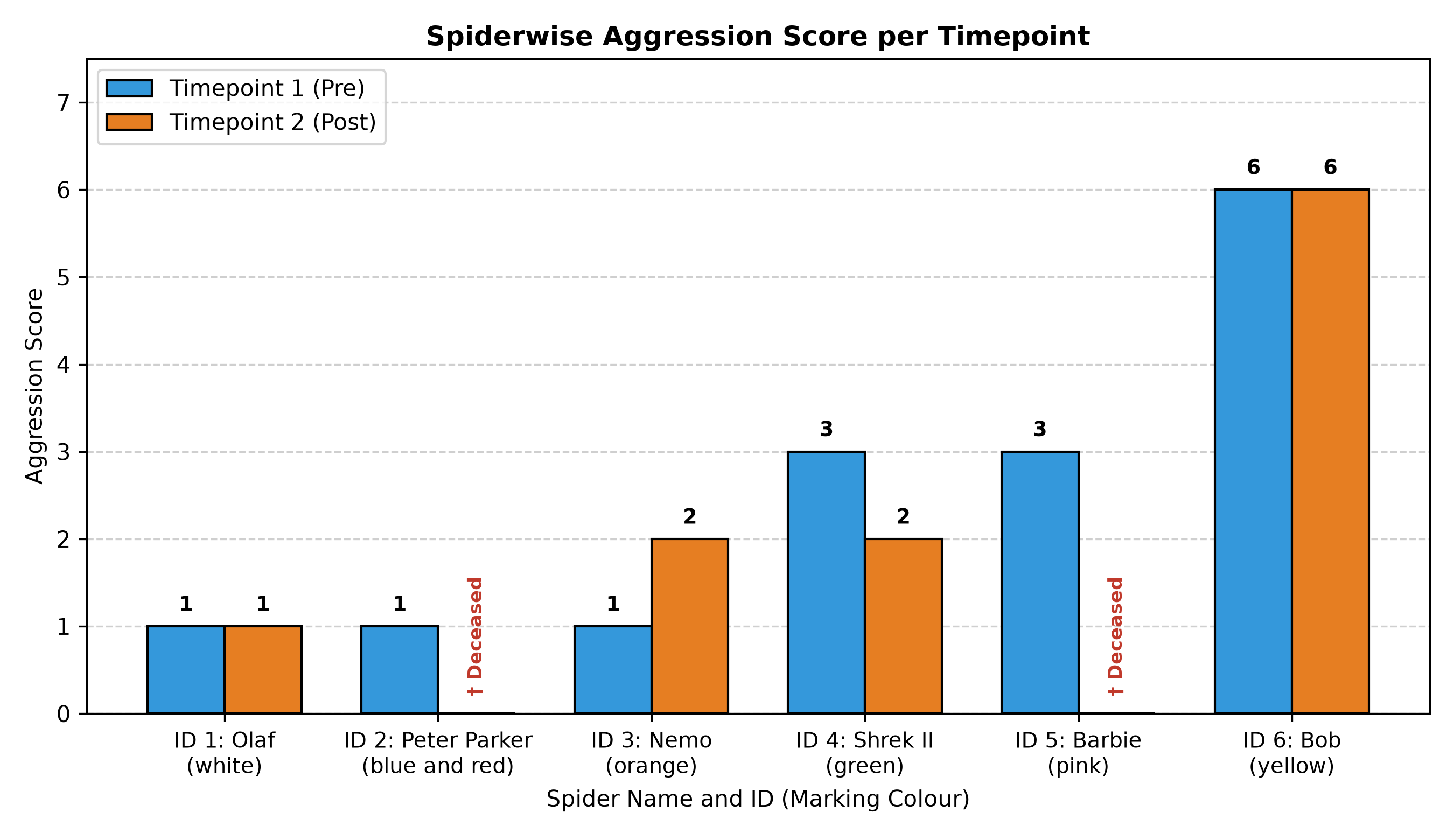 |
|---|---|
| Individual longitudinal boldness score trajectories | Individual longitudinal aggression score trajectories |
Discussion
Behavioral Specialization During Prey Encounters
During live prey exposure, individuals displayed consistent division of labor:
- Bob (Spider 6, Yellow): Showed the highest aggression score (6/6, leg raise) and served as the sole primary attacker, actively stalking, immobilizing, and envenomating the prey.
- Shrek II (Spider 4, Green): Exhibited persistent locomotor activity, engaging in web stabilization and wrapping the prey items in silk sheets.
- Olaf (Spider 1) and Nemo (Spider 3): Remained quiescent in retreat chambers, exhibiting lowest aggression scores.
Temporal Personality Stability
Every surviving individual exhibited a minor, uniform reduction in boldness score post-trial (
References
- Wright, C.M. et al. (2014). Selection on social spider colonies for boldness and aggressiveness. Behavioral Ecology, 25(6), pp. 1485–1492.
- Grinsted, L. et al. (2013). Subsocial and social spiders: behavioral traits and ecological specialization. PLOS ONE, 8(6), e65830.